How to choose a fragrance oil for your candles
A beautiful name can start a conversation. The right fragrance keeps it going. Before choosing an oil for your candle, decide what the finished candle needs to feel like—and what it needs to do.
Start with a small, specific brief
Write one sentence about the candle you want to make. “A soft floral candle for a quiet evening” is more useful than “something luxurious.” It gives you a way to compare options without letting the newest sample change the whole idea.
Add three details: the setting, the person you are designing for and the character you want. A lively gifting collection may need a different mood from a candle intended for a reading nook. These are creative choices, rather than claims about what a fragrance will do to someone’s health or mood.
“For someone who enjoys floral scents, I’m creating a gentle rose-led candle with a warm finish, in a small jar for evening use.”
Keep this brief beside your sample notes. If an oil smells wonderful but does not fit, save it for another collection instead of forcing it into this one.
Check the application before the aroma
Ask the supplier whether the specific oil is intended for candle use. A product name alone does not tell you whether it suits wax, incense, soap or a diffuser. Make sure you are looking at the exact product code, since similar names can refer to different compounds.
Request the current product guidance and relevant handling information. Where an IFRA Certificate of Conformity is supplied, it should cover the fragrance mixture and intended application. IFRA explains that these certificates are issued by fragrance suppliers; they do not replace a complete safety assessment. Read IFRA’s explanation ↗︎
Keep a simple folder for each shortlisted oil: product code, supplier contact, documents received, date and your own test notes. It makes repeat orders and follow-up questions much easier.
Choose a small, purposeful shortlist
Give every sample a reason to be there. You might choose one familiar floral, one fresh direction, one woody direction and a more unexpected option. Within a single collection, compare variations of the same brief: a brighter rose, a softer rose and a rose with a warmer background.
Browse rose fragrances, lavender blends or oud-led options as starting points. The catalogue name is a navigation aid; your evaluation should decide whether the actual sample fits.
Do not treat the most expensive oil as the automatic winner. Compare the amount your validated formula needs, the finished aroma and the cost of producing the candle—not just the price of a bottle.
Move from the sample to your own wax
An initial impression helps you shortlist; a finished candle is a separate test. CandleScience’s fragrance evaluation guide distinguishes bottle, blotter and finished-product assessments, because each reveals a different part of the experience. Read the evaluation guide ↗︎
Give each test a code and record the exact wax, container, wick, fragrance batch and measured weights. Start from the suppliers’ guidance for those materials. If you change a component, record it as a new version so an encouraging result can be repeated.
Compare your finalists against the original brief, then choose one to develop properly. Keep a second candidate in your notes for future experimentation, without assuming it can be swapped into the same candle formula.
Before you place a larger order
- Confirm the exact product code and the quantity unit on the quotation.
- Check whether the price includes tax and how dispatch is scheduled.
- Keep the approved sample’s batch details with your production notes.
- Ask what information the supplier needs for repeat orders.
- Reserve time and material for your own finished-product testing.
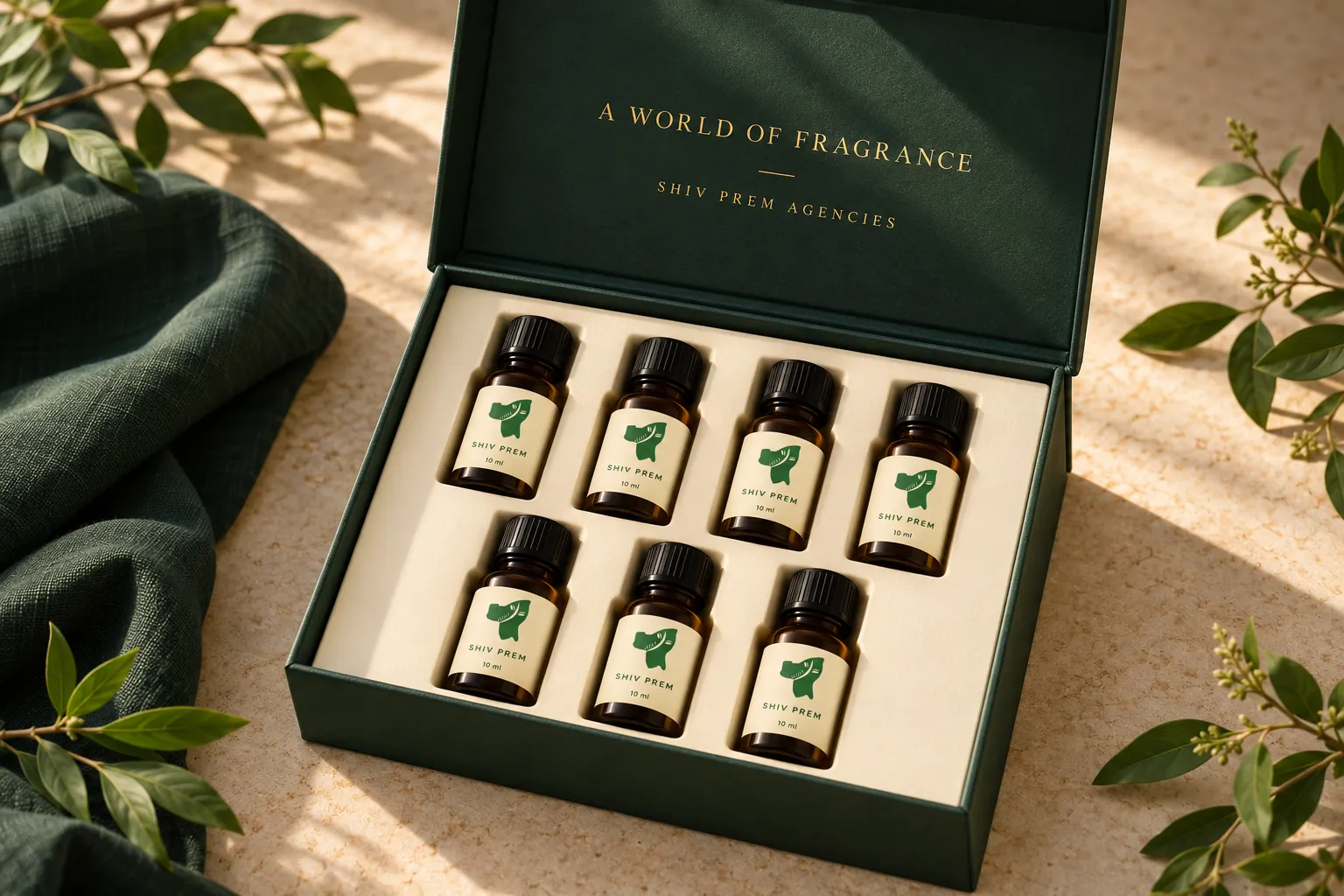
Shiv Prem Agencies lists bulk fragrance prices per kilogram. The seven-fragrance sample box contains 10 ml of each selected fragrance for ₹899.10. Use it to begin your shortlist; a small sample is not a substitute for a complete production trial.
Choose for the finished candle, keep the product code, and let a clear brief guide the shortlist.